With the school year coming to a close, the quality of the phone ban may be up for discussion. Phones were banned in the 2022-23 and the 2023-2 school year. The next year, there was no phone ban. Then at the start of 2025, students were supposed to put their phones away at the front office when they arrived at school.
“We are slowly trying to help students focus on school while you are in school,” said Deirdre Schreiber, NYHS principal.
The main thing the phone ban seeks to remove is the phones themselves, rather than what the phones can do. So when people are walking down the halls they socialize instead of scrolling on their phone.
“Even if computers can fulfill the same functions as phones,” said Schreiber, “they are not quite the same in terms of their effect on the users.”
There have been attempts to mitigate this. The school has blocked social apps on the wifi itself.
“Luckily, what we do currently now avoids any type of spyware or intrusion,” said Tyler Yale, registrar and technology specialist. “It’s just an internet level connection so if your phone or your laptop tries to connect an outbound connection to Facebook or Instagram it will just block it.”
In terms of technology, it is an ever-changing battlefield. There is no one perfect solution that is the perfect mix between privacy and security. One must always be sacrificed for the other. With the rise of VPNs becoming more accessible, these blocks have little to no effect, and seem to zero out in terms of their usefulness.
“The honest truth is that things like Discord and WhatsApp are not needed for school,” said Schreiber. “There is a time and place outside of school where you can engage with these apps.”
Some students have reported being unhappy with the current phone ban.
“People that use their phones for bad things keep their phone,” said David Liansky, a sophomore. “It’s not necessarily preventing them from having their phone in class.”
However, as the school year progressed, students say that they feel that people got better at hiding their phones during school hours.
“The phone rule hasn’t gotten less strict,” said freshman Bella Harvey. “The kids are just better at avoiding it and breaking the rules.”
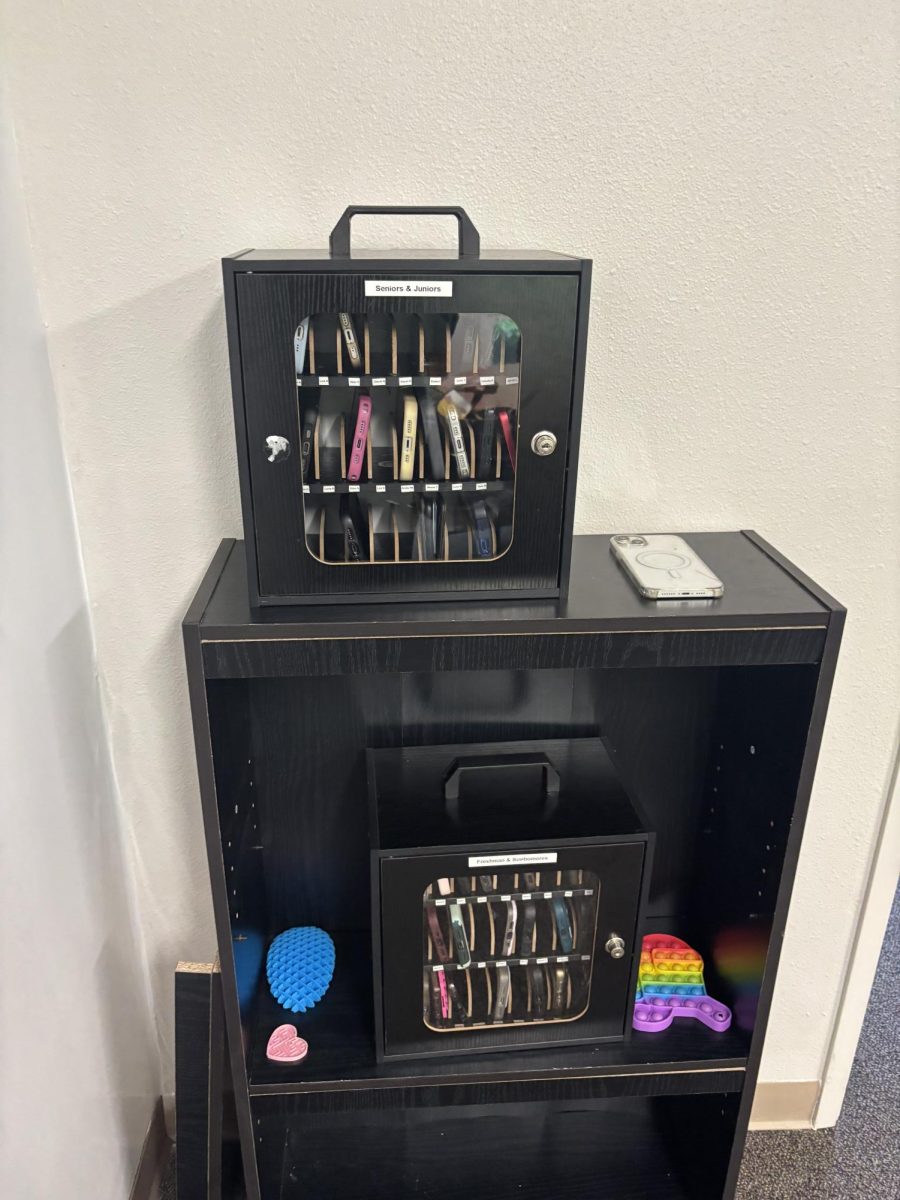
For example, there have been responses to kids not turning in their phones. The phone turn-in box used to be in Ms. Murray administrative coordinator’s office and now it is in Schreiber’s office. This ultimately leads to students who need to use their phones having to jump through more hoops in order to get them, while students who are bypassing the rules remain unaffected.
“All I would say is, as we try to determine policies and procedures around these things,” said Schreiber. “We are constantly evaluating what is in the best interest of students in terms of healthy habits, and ability to learn and it is a very complicated issue and landscape.”
The phone ban in the state that it is currently being implemented in isn’t exactly the most effective of limitations, with students being allowed to use their phones during lunch or their computers during class to message friends or scroll on social media. With little being done to address this problem, if anything, the phone ban in its current state is more of a neutral limitation as it doesn’t seem to accomplish as much as the administration hoped.
“But I feel good,” said Schreiber. “I feel good about what we are doing and having this at the forefront of our conversations.”