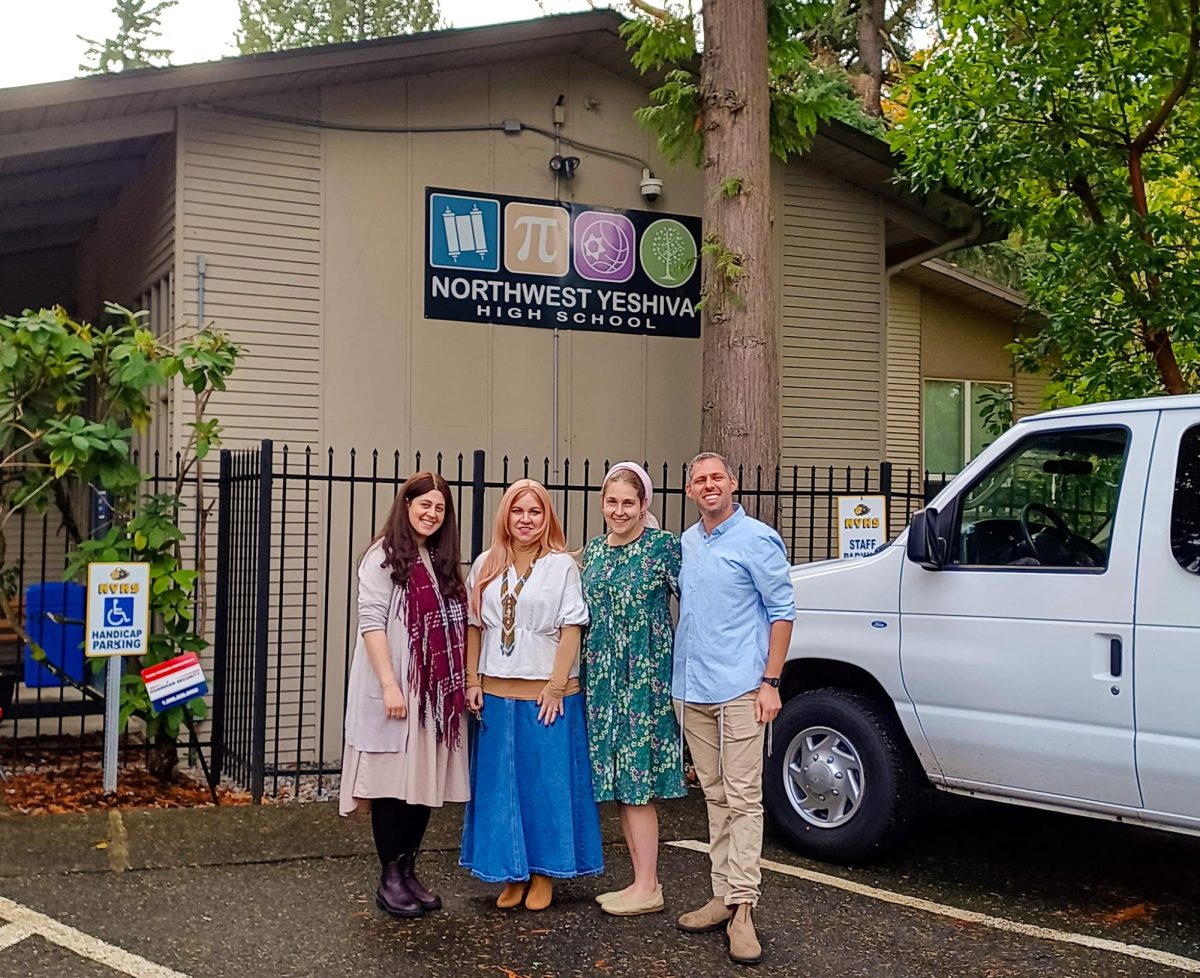
Rabbi Fox has worked at Northwest Yeshiva High school for 40 years. He has seen the school grow from being in the basement of Seattle Hebrew Academy to 60 students in a different building. The Mane Idea is asking Rabbi Fox about his experience over the years and how the school has changed.
Q: What was it like when you came to NYHS 40 years ago?
A: The school was so small, 30 students, and that the school was only 10th, 11th, 12th grade. We didn’t have 9th grade. The 9th grade was part of the Seattle Hebrew Academy, [but they] took their Judaic studies with the high school. We [NYHS] were located in the basement of Seattle Hebrew Academy, although when we first came that they were doing renovations, the basement wasn’t even available. So, we met in a different room for a couple of weeks. It was nothing like now. This facility might not be the greatest in the world, but compared to the basement at the Academy this is like heaven.
Q: How have the students changed?
A: I came here in 1980 so there have been a lot of changes over the years. The first thing is that students definitely do change, and so over the years you will encounter students that come to the school with different backgrounds, different levels of commitment, different ways of social skills in terms of how they interact with each other. You see also that there are patterns that emerge and reemerge, you sometimes see patterns in terms of behaviors that will appear, disappear for a while, then recur years later.
Q: What do you consider to be good students?
A: Most importantly is their interest, their commitment to study, to learning, and to grow. It takes time to evaluate that.
Q: What made you stay for 40 years?
A: I think that for every individual, for me or for everybody, it is important to feel that you’re doing something that makes a difference, that you’re doing something that has some significance. So this was really a unique opportunity, because I felt that this was a community, and this was a school in which I could make a really significant impact. And so as long as I felt that I was achieving that, I was motivated to continue being here at NYHS and when I reached a point where I felt that maybe somebody else could do a better job than me. I felt, no, I had maybe done the best I could. It’s time for me to retire. That’s what I did.
Q: Are you staying here next year or a couple years after that?
A: I am here as long as I’m welcome, as long as the students are interested in learning. I enjoy studying and learning with the students. I mean, I have a great time every day. How many people can say they go to work every day to have a great time? You walk in this class and you’ll know I’m having a great time. So I’d be crazy not to come back right from having a great time.
Q: What is your favorite thing that the school has done over the years?
A: A few years ago, I think what most impressed me was the improvement of the Tefillah here at the school. I felt that when I was Head of School, it was very difficult to motivate students to, first of all, be appropriate, and then to engage [in Tefillah]. When I came back, everybody was engaged, but I thought just the decorum and respect for Tefiallah had improved significantly. When I first came to the school and it was small, there was a very strong sense of school community within the students. And I think as a school grew, it deteriorated. I think it’s better now.
Q: What makes those classes enjoyable for you?
A: A lot is dependent on students, so they’ve got to engage. They have to be interested in what it takes to work on otherwise large material they already learned. They have to have an open mind. I like it because it involves and requires an advanced type of thinking that is slowly lacking in our world today, the capacity to follow an argument. If you listen to interviews or you listen to debates between people on TV, you’ll notice that they have difficulty hearing and responding to each other’s points. Either because they don’t want to, or they don’t feel it’s necessary, or they can’t. So when you’re learning gemara, you have to learn to follow an argument and to make an argument, and it has to be compelling, and it has to be valid. Hey, just a lifetime skill that so many students that have graduated from the school have come back and told me that it gave them an advantage in life to have that capacity to follow an argument and to make an argument.
Q: Since we have a whole bunch of new staff and you’ve been here for a long time, what advice do you have for them?
A: There’s no one size fits all in education. You have to look at the students, get to know them, understand their learning styles and what they need, and you have to respond to that. You can’t just say, this is how I teach. This is how you teach and you better have students that learn that way. But if you don’t, it’s a dead end. So it’s the variety of tools that they have in their box and the capacity to use that they feel comfortable with that creates a good faculty. (i love, love, love this)
Q: Do you want to add anything else?
A: It does pay once in a while to step back and to appreciate the things that we have, even if we can’t constantly focus on that. I think the students here, everybody here, has to realize what a special place this is because when you look at the world out there at large, you wonder whether or not high school students are developing values? And how, based on what, where do those values come from, and how will they translate those values into their lives? Provide you the tools that you need for life are not just knowledge of the sciences, the hard science and the social sciences, or even just knowledge of Halacha. Value-driven education facilitates that, and that’s an enormous blessing. Working in that type of environment, [one] that is committed to a value driven education is just so special.